
 .
.  .
.  .
. 
 .
. 
Continuously from last month, I translated this verse from Haiku Harvest Vol. 5, No. 1 - Fall & Winter 2005.
challenging to express a culture-background scene in EL again.
The author is Cristian Mocanu of Romania; this poem is among five line haiku called Cinqku..
which I had not heard of before. Mr. Cristian kindly explained about Cinqku in his email;
also with a wonderful tanka for me! I put the information and his tanka below.
I tried to translate his cinqku into Japanese in the Tanka rhythm.
Christianity is not in my tradition, but I can imagine how the author feels
in their tradition and environment very well through this verse.
先月に引きつづき、 俳句・ハーベストから再び地域文化の色濃い作品を採りあげます。
前回のインドの瞬間とはうってかわって、これはいかにもルーマニアの秋の光景をしのばせる
Cristian MocanuさんのCinqku(5行俳句)という形式の作品です。
不勉強にてCinqkuは初耳ですが、日本語では短歌にあてていいかなぁと、試訳しました。
著者からCinqkuについての説明と、地球語のためのすてきな短歌もお贈りいただいたので、それらも下に載せました。
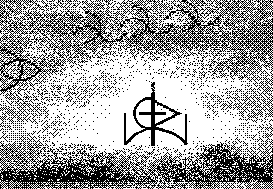 The
Original English Cinqku by Cristian Mocanu
The
Original English Cinqku by Cristian Mocanu


 {
God, the cross symbol}: Christian God (キリスト教の神)
{
God, the cross symbol}: Christian God (キリスト教の神) {
{ ear-shape,
  wave}: sound (音)
 {
{ sense, ear-shape}: ear(s)
(耳):{
sense, ear-shape}: ear(s)
(耳):{ a part of the sun ,
  down}, time}: evening (夕方){
 road/way of
  spirit}: religion/religious
(宗教的な) {{
,}: sound,
spirit}: religion/religious
(宗教的な) {{
,}: sound,  balanced,open, entertain}:
music (音楽)
: multiple instances of dots are used to indicate a pause (余韻の間): {
balanced,open, entertain}:
music (音楽)
: multiple instances of dots are used to indicate a pause (余韻の間): { much,time,
 object}: old, aged (of a thing) (古い) {
 long/with length,
 sheet-type
thing}: tape/sash (テープ) {
sheet-type
thing}: tape/sash (テープ) { preposition 前置詞,
  This grammatical notation to form a d-verb: meaning that the
subject becomes in the condition shown by the following character/phrase;
or the subject does the following action}: this verb modifies the front
word (前の語を修飾する動詞){33,15,
sound,(spreading energy,
entertain), with
This grammatical notation to form a d-verb: meaning that the
subject becomes in the condition shown by the following character/phrase;
or the subject does the following action}: this verb modifies the front
word (前の語を修飾する動詞){33,15,
sound,(spreading energy,
entertain), with  a language}:
song(s) with words (歌)
: (verb) sing a song with word (うたう){
a language}:
song(s) with words (歌)
: (verb) sing a song with word (うたう){ the heading direction,
preposition} : to, for~へ(の){{
the heading direction,
preposition} : to, for~へ(の){{ true,
true, one}: absolute,
 existence}: God (絶対神){
 situation/state,
preposition}: (preposition) as (the condition of ...) (~なふうで(の) {
situation/state,
preposition}: (preposition) as (the condition of ...) (~なふうで(の) { recognition,
  the same}:
similar, near (同様、差がない){
true,
the same}:
similar, near (同様、差がない){
true,  circle}: perfect (完璧) {
 : bracket to show the type of the following name,
language}: to show the following phonetics are for a name of a language
(次は、言語の1種であると示す類別記号)
: bracket to show the type of the following name,
language}: to show the following phonetics are for a name of a language
(次は、言語の1種であると示す類別記号)

 : (as phonetics shown between the phonetic brackets) Latin (: a vowel between [a] and [e]) (表音で「ラテン」){
preposition,
: (as phonetics shown between the phonetic brackets) Latin (: a vowel between [a] and [e]) (表音で「ラテン」){
preposition,  joined}: with
(~とともに(の): I, my,
me (according to its position); this hand sign points the center
of the chest by the thumb (私)
joined}: with
(~とともに(の): I, my,
me (according to its position); this hand sign points the center
of the chest by the thumb (私)Information about Tanka, Cinquain and Cinqku sent by Cristian Mocanu:
In the early 20-th century, Adelaide Crapsey (1878-1914), an American poet, developed a form she called cinquain. Since this form has striking similarities to tanka, many claim that she devised it under Japanese influence, but, as all her cinquains-28 in all-were published posthumously, no proof was found in support of this claim. Many English speaking poets have since used this form (sometimes also known as "American cinquain"): 5 verses with a syllable structure: 2, 4, 6, 8, 2; no rhyme but (unlike tanka) titled.
In this year 2005, Mr. Dennis Garrison thought of a fusion between cinquain and haiku, and developed a form he called cinqku. Its syllable structure is: 2, 3, 4, 6, 2. Like haiku, it is untitled and it should have a kireji and a slightly humorous note. A lot of poets have started to write cinqkus since, but it's still the newest poetry form there is.
(* Mr. Dennis Garrison is the editor of Haiku Harvest site where this Cristian's original cinqku is)
Tanka written for Yoshiko by Mr. Cristian Mocanu:the improvised bridge-
many cross it, to and fro,
o’er swollen waters.
even sitting at your desk
you can span the seven seas..... Cristian, thank you very much for encouraging me.
I hope EL will beautifully work like this in the near future. Yoshiko